
Balbhadra Kunwar (30 January 1789 – 13 March 1823) was a Gorkhali military General, Commander and administrator in the Sikh Empire and the Kingdom of Nepal. He was highly praised for his military skill for the defence of Nalapani fort in the Anglo-Nepalese War (1814–1816).[1][2] He was a captain in the Nepalese military and was tasked as commander to protect the forts of Dehradun.[3]
His given name Balabhadra is the name of Baladeva (Balarama), the elder brother of Krishna. It is an amalgamation of two words; Bala (strength) and Bhadra (auspicious).[4]
Balbhadra Kunwar
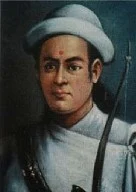
| Born | 30 January 1789 |
| Birthplace | Bhanwarkot, Kavre, Gorkha Empire (present-day Bhanwarkot, Panchkhal Kavrepalanchok District, Nepal) |
| Occupation | Gorkhali military General, Commander and administrator in the Sikh Empire and the Kingdom of Nepal. |
| Nationality | Nepali |
| Known for | Anglo-Nepalese War |
| Awards | National heroes of Nepal (posthumous) |
Early Life
He was born to father Chandrabir Kunwar, resident of Bhanwarkot currently Panchkhal Municipality in Kavrepalanchowk District. His mother Ambika Devi was a sister of Kaji Ranajor Thapa and daughter of Bada Kaji Amar Singh Thapa. His father Chandrabir was son of Jaya Krishna Kunwar and grandson of Ashiram Kunwar.[4]
His brother Birabhadra Kunwar was military commander in Kumaun and Kangra front (1809 A.D.) as well as governor of Garhwal.[5]
The Anglo-Nepal War 1814–1816
As commander of the Gorkhali forces in Dehradun, Capt. Balbhadra Kunwar was handed the responsibility of defending the area. The expanding Nepali/Gorkhali State had since the mid-late 18th century expanded the nation’s border on all sides, which eventually led to conflict with the British East India Company and a war followed.[6]
Realizing he could not defend the town of Dehradun, Capt. Balbhadra Kunwar withdrew to the strategic hill fort of Khalanga with an army strength of 600 including women and children against the British stronghold of 3,000–3,500 troops.[2]
In October 1814, Major General Sir Rollo Gillespie advanced with 3,500 troops to occupy the Nepali territories between the Ganges and Yamuna rivers. Captain Balbhadra Kunwar maintained his position at Nalapani to check the advance.[5]
“Go capture the fort that you could not win by war, but now we have left it at our own will”.
Treaty & aftermath
A peace treaty was signed on Dec 2, 1815 between King Girvan Yuddha Vikram Shah and the British East India Company, known as the Sugauli Treaty.[7]
Under Maharaja Ranjit Singh
After the war, he went to Lahore to serve under Maharaja Ranjit Singh and was appointed General and commander of the Goorkha regiments in the Sikh Empire.[4]
Death
During the Sikh-Afghan war of 1822, Balbhadra Kunwar was killed by Afghan artillery in Naushera in the Peshawar region.[4]
Legacy
Following the Anglo-Nepali War, the British East India Company erected a war memorial at Nalapani in honour of the Gorkhalis and Capt. Balbhadra Kunwar, praising their bravery.[1]